When the Scales Tilt: How Presidential Power Over the Supreme Court Threatens the Balance of Democracy
The Supreme Court was never meant to be a weapon. But today, lifetime appointments, partisan confirmations, and rulings that roll back rights reveal a judiciary increasingly detached from justice. If we don't demand reform—and become it—we risk losing the very democracy we’re trying to protect.

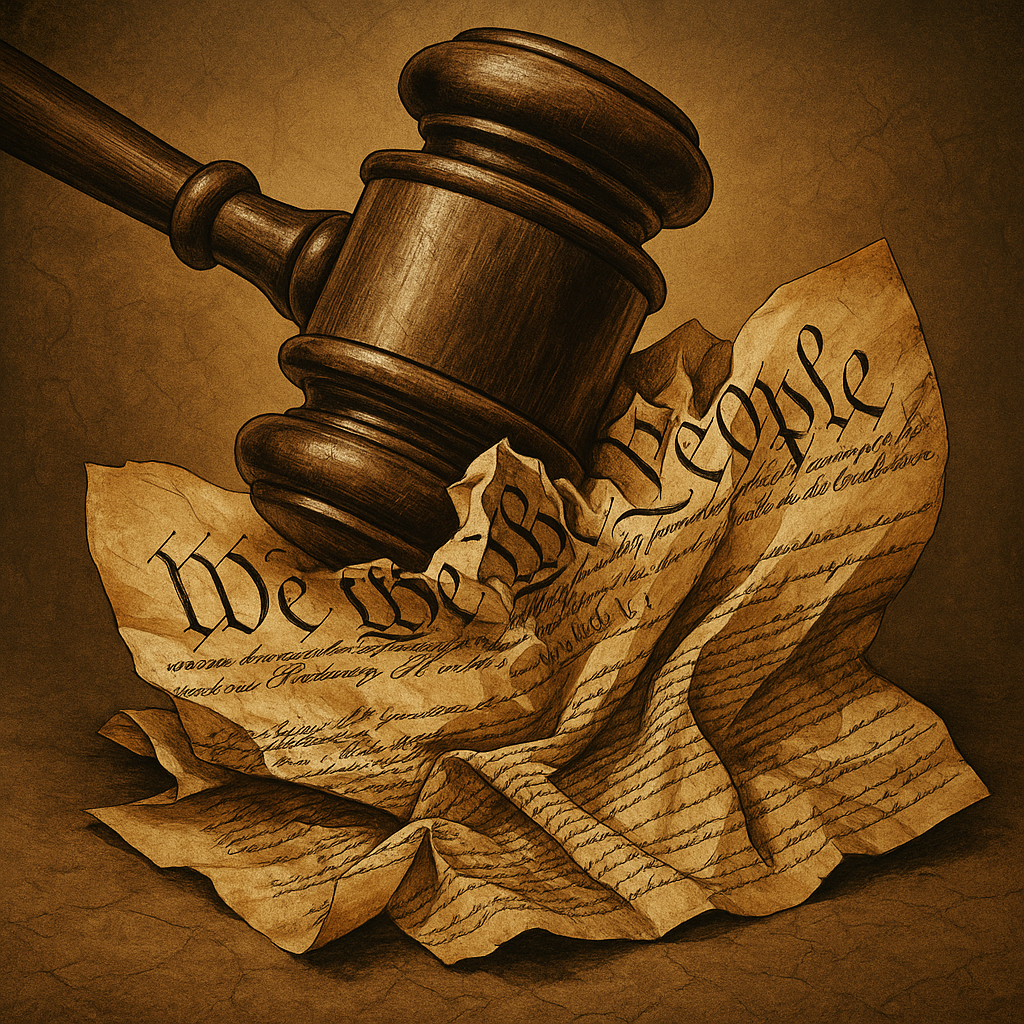
The American experiment was built on the idea of checks and balances: three co-equal branches of government designed to keep each other honest, restrained, and responsive to the people. But that delicate balance is under increasing threat. One of the clearest—and most consequential—ways this system is being undermined is through the presidential power to nominate Supreme Court justices.
A Power Rooted in the Constitution—And Strained by Politics
From the founding of the Republic, the U.S. Constitution granted the president the authority to nominate Supreme Court justices, with the advice and consent of the Senate. This framework, outlined in Article II, Section 2, was intended to ensure a collaborative and balanced process:
“He [the President] shall nominate, and by and with the Advice and Consent of the Senate, shall appoint… Judges of the Supreme Court.”
The founders envisioned this authority being exercised with care, tempered by Senate review, and directed by a sense of civic responsibility—not partisan strategy. As Alexander Hamilton wrote in Federalist No. 76:
“The possibility of rejection [by the Senate] would be a strong motive to care and deliberation in nominations.”
Yet what was designed as a check has, over time, become a lever of power. Nominations are now increasingly calculated for political advantage, with long-term consequences that strain the integrity of judicial independence.
1. Lifetime Appointments, Generational Consequences
Supreme Court Justices serve lifetime terms. This means a president can shape the Court for decades—far beyond their own presidency. President Donald Trump, for instance, appointed three justices in just four years, creating a 6–3 conservative supermajority that will influence U.S. law for a generation or more (SCOTUSblog).
The framers intended the Court to be independent of political cycles. Yet increasingly, nominations are timed and strategized for political gain rather than judicial prudence. A single-term president with a minority of the popular vote can tip the scales for decades. That should trouble anyone who believes in representative governance.
2. Eroding the Separation of Powers
The three-branch structure is meant to ensure no single branch becomes too powerful. But the Executive's power to appoint justices who align with their ideological goals has led to a judiciary that sometimes acts more like an extension of a political party than a check on it.
As constitutional scholar Erwin Chemerinsky notes: "The Court has increasingly become a political institution. That undermines its legitimacy and the public’s trust in its decisions" (Chemerinsky, The Case Against the Supreme Court).
3. Minority Rule Through the Courts
Twice in recent decades, presidents who lost the popular vote have appointed a majority of the Court. George W. Bush in 2000 and Donald Trump in 2016 both lost the popular vote but won the Electoral College—and the power to reshape the Court.
The result is a judiciary capable of overturning policies supported by the national majority, such as abortion rights (as seen in Dobbs v. Jackson Women’s Health Organization, 2022) or environmental protections. This is not merely a legal issue—it is a democratic one.
4. A Broken Confirmation Process
The Senate's role in confirming justices has become intensely partisan. In 2016, Senate Majority Leader Mitch McConnell refused to hold hearings for Merrick Garland, citing the upcoming election. In 2020, the same Senate rushed through Amy Coney Barrett’s confirmation mere weeks before the election.
This blatant hypocrisy illustrates how the process is no longer about qualifications or balance. It’s about ideological control. As law professor Leah Litman put it: "The current process undermines the Court’s legitimacy by making it look like just another political prize" (Litman, NYU Law Review).
Already Unfolding: The Dire Risks We’re Living Now
This is no longer a warning about the future—these dangers are already here:
- Loss of Reproductive Autonomy: The Court’s reversal of Roe v. Wade in Dobbs v. Jackson stripped constitutional protections from millions, forcing pregnant people in many states to carry unwanted or unsafe pregnancies. This has already led to avoidable trauma and medical emergencies—especially for low-income and marginalized communities.
- Weaponization of Religion: Decisions like Kennedy v. Bremerton School District (2022) and 303 Creative v. Elenis (2023) have enabled public officials and businesses to use religious belief to justify discrimination—particularly against LGBTQ+ people.
- Environmental and Regulatory Rollbacks: In West Virginia v. EPA (2022), the Court severely limited the government’s ability to regulate carbon emissions, dealing a blow to climate change efforts. In Loper Bright v. Raimondo (2024), it overturned Chevron deference, curbing federal agencies' ability to enforce regulations in areas like healthcare, labor, and consumer protection.
- Voting Rights Undermined: Through decisions such as Shelby County v. Holder (2013) and Brnovich v. DNC (2021), the Court has gutted core protections of the Voting Rights Act, emboldening voter suppression laws across the country.
- Corporate Power Expanded: The Court’s rulings have consistently favored corporate interests over worker protections and consumer rights (Epic Systems Corp. v. Lewis, 2018; Janus v. AFSCME, 2018).
5. The Risk of a Delegitimized Court
The U.S. Supreme Court has no army, no budgetary control, no direct enforcement mechanism. Its power lies in the respect it commands. When that trust erodes, so too does its ability to function.
According to a 2023 Gallup poll, only 41% of Americans approve of the way the Supreme Court is handling its job—a near-record low (Gallup). When people stop believing in the impartiality of the Court, the social contract itself begins to fray.
A Call for Reform—and Resistance
Let us remind those in power of what they swore to uphold:
- To the Justices of the Supreme Court: Your oath is not to ideology or party, but to the Constitution and the people. Neutrality under the law is your sacred duty—not optional, not rhetorical.
- To our elected officials: You are not our rulers. You are employees of the people, tasked with protecting our rights, not dismantling them.
Solutions exist. Term limits for justices could restore some balance. An independent bipartisan commission could vet nominees. Greater transparency and recusal standards could restore faith in the Court.
But let us be clear: these are not theoretical concerns. The erosion of judicial neutrality and the consolidation of power within an increasingly politicized Court threatens every constitutional right—especially those of women, queer people, people of color, and anyone living outside the ideological majority currently in power.
We cannot afford to watch in silence. We must demand reform—and we must be the reform. We must vote like our lives depend on it—because for many, they do. We must pressure lawmakers, educate communities, and hold the line wherever justice is being rewritten.
Let this be your alarm. Let this be your rallying cry.
"The Watcher sees. The Vigil gathers."
And it is time to gather.
Citations:
- SCOTUSblog. https://www.scotusblog.com
- Chemerinsky, Erwin. The Case Against the Supreme Court. Yale University Press.
- Litman, Leah. NYU Law Review. https://www.nyulawreview.org
- Gallup Supreme Court Poll, 2023. https://news.gallup.com/poll/512471/supreme-court-job-approval-still-near-record-low.aspx
- Dobbs v. Jackson Women’s Health Organization, 597 U.S. — (2022).