The Algorithm Eats Empires: How Gingrich, Gulf War Optics, and Digital Spectacle Rewired Politics
This is a call to action: to break the algorithmic grip on truth, reject corporate control, and rebuild community power before it's too late.

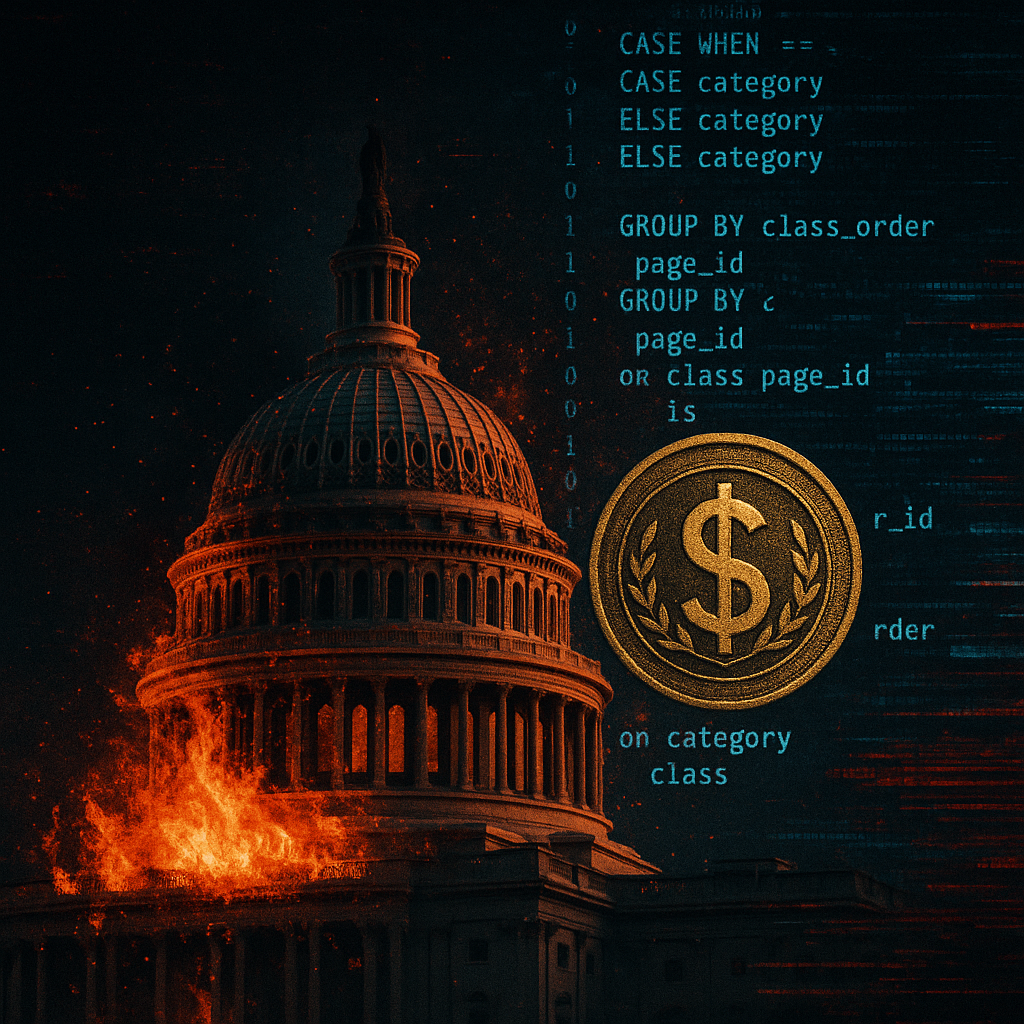
We’ve seen this before. But this time, the fire is digital.
In the 1990s, a perfect storm quietly reshaped American politics—though most didn’t realize it at the time. Newt Gingrich weaponized Congress with inflammatory rhetoric and performative obstruction, while the Gulf War birthed the 24-hour news cycle, proving that war, fear, and spectacle could keep viewers hooked around the clock. Gingrich wasn’t initially taken seriously by many in Washington; he was seen as an attention-seeking backbencher, a fringe figure too brash and undisciplined to threaten the institutional order. But that underestimation allowed him to build power unchecked. By the time political insiders realized the scope of his strategy, it was too late. It was the beginning of something seismic.
Today, we’re living in that storm’s evolved form—amplified by algorithms, livestreamed insurrections, and a news industry more concerned with clicks than clarity. The echoes of Gingrich's tactics are clearest in Donald Trump: both men understood that performance could eclipse policy, that dehumanizing your opponents could energize your base, and that media coverage—good or bad—was a tool to dominate the public narrative. Gingrich trained the party to prioritize confrontation over cooperation; Trump took that ethos and infused it with spectacle, grievance, and personal brand-building. In many ways, Trump is Gingrich’s ideological heir, but wielding far greater digital reach and cultural saturation.
🔁 The Gingrich Blueprint
Newt Gingrich didn’t just reshape the Republican Party—he rewrote the political playbook:
- Encouraged GOP freshmen to treat Democrats as the enemy, not colleagues.
- Gave firebrand speeches to empty chambers, knowing they’d air on C-SPAN.
- Trained a generation of politicians to perform, not govern.
This shift was widely underestimated. Many in D.C. thought Gingrich was just a loudmouth. But by 1994, he had led the GOP to capture the House for the first time in 40 years with his "Contract with America," leveraging the media’s growing appetite for confrontation over substance. Democrats, too, bear responsibility—they responded with caution, triangulation, and strategic silence, hoping to weather the storm rather than confront it head-on. Some embraced Gingrich’s methods in diluted form, prioritizing electability and donor approval over meaningful resistance. In doing so, they helped normalize the tactics that now define our dysfunction.
[Source: NPR, "Newt Gingrich: The Man Who Broke Politics"]
📺 The Media Learns to Sell War
The 1991 Gulf War changed how war was reported and consumed:
- CNN delivered war in real-time.
- Saturation coverage turned military action into a media product.
- Trust in the government surged temporarily—but so did public appetite for spectacle.
What Gingrich and CNN revealed, separately but concurrently, is that drama—especially nationalistic or combative—sells. And both parties, eventually, adjusted accordingly. For journalism, this marked a dangerous turn: news began to compete with entertainment, and storytelling gave way to sensationalism. As conflict became content, public consumption habits shifted. Viewers tuned in for outrage, not information. Over time, saturation and spectacle created a numbing effect—people were inundated with crises but given little context or clarity. The result? A disengaged public, increasingly skeptical of media yet addicted to its dramatics, struggling to discern truth from narrative and falling into apathy, fatigue, or tribal allegiance.
[Source: Columbia Journalism Review, "How the Gulf War Transformed American News"]
🧨 Now: The Spectacle Evolves
Today’s political reality is the logical conclusion of those shifts, only scaled and digitized:
- Politicians like Trump, MTG, and others perform not for constituents—but for viral reach.
- Outrage is algorithmically rewarded on TikTok, Twitter/X, YouTube, and Meta-owned platforms like Facebook and Instagram, where engagement-based sorting prioritizes divisive content and emotional manipulation over balanced reporting.
- Truth is filtered, distorted, or ignored if it doesn't monetize well.
- Fringe ideology spreads faster than nuance.
According to a study published in Science, false information spreads six times faster than the truth on social media. The political economy now runs on attention—not accuracy. Journalists, meanwhile, find themselves caught in a double bind: pressured by shrinking newsrooms, 24/7 deadlines, and dwindling public trust, they are often forced to prioritize engagement over depth. Corporate ownership and algorithm-driven platforms demand speed and controversy, not context. Fact-based reporting struggles to compete with viral distortion, leaving even principled journalists constrained by a system that punishes nuance and rewards outrage.
[Source: Science Magazine, "The spread of true and false news online"]
🧠 What We’ve Lost
- Shared reality: A consensus on what is fact has vanished.
- Legitimacy: Institutions no longer command respect across divides.
- Deliberation: Congressional hearings have become performance venues.
Meanwhile, lobbyists and tech billionaires have filled the vacuum—and reshaped the laws to keep it that way. Through campaign donations, direct lobbying, and dark money PACs, they have bought and paid for legislation that protects monopolies, suppresses competition, and deregulates the very platforms and industries that fuel disinformation. From Section 230 protections for tech giants to corporate tax loopholes and union-busting laws, the policy landscape increasingly reflects the interests of capital, not citizens. The voices most amplified are the ones that entertain or enrage—not inform—because those are the ones that maintain the power structure now codified into law.
🧭 A Fork in the Road
Back in the Gingrich era, there were still guardrails—norms, relationships, accountability. Today, those guardrails are shredded. Social media isn’t just a mirror—it’s an accelerant. And the consequences are not abstract—they are deeply personal and painfully real. Families are divided by algorithm-fed conspiracy theories. Marginalized communities face online harassment that spills into physical violence. Public health crises become battlegrounds for disinformation, eroding trust in science and costing lives. Economic inequality widens as tech and media monopolies flourish, while everyday people are left with eroded labor rights, shrinking access to truth, and a democracy that increasingly feels performative instead of protective. The spectacle doesn’t just distort reality—it undermines the systems meant to safeguard it.
We can’t put the genie back in the bottle. But we can:
- Reinvest in independent media ecosystems. This means supporting nonprofit and grassroots news organizations that prioritize investigative journalism and local accountability over ad revenue and corporate sponsorship. It also involves subscribing to reader-supported platforms, funding community media cooperatives, and advocating for public policies that protect journalistic integrity—like protections for whistleblowers and antitrust measures to prevent monopolization of information channels.
- Build digital literacy into our communities. This includes integrating media literacy education into school curricula, from elementary through higher education, so students learn to identify misinformation, understand algorithmic bias, and navigate online spaces critically. Communities can also offer public workshops through libraries, neighborhood centers, or mutual aid groups that empower people to question sources, decode clickbait, and recognize when they’re being emotionally manipulated online. When people understand the tools shaping their worldview, they gain agency—and resilience—in an increasingly chaotic digital environment.
- Elect leaders who value truth over trendlines. Start by researching local races—school boards, city councils, state representatives—where your vote can directly impact community values. Look beyond party labels and examine a candidate’s track record, funding sources, public statements, and community involvement. Attend town halls, follow candidate forums, and ask hard questions. Use nonpartisan tools like BallotReady, Vote Smart, or your local League of Women Voters to compare stances and fact-check claims. Representation starts when we engage not just every four years, but every chance we get.
- Organize across platforms—not just around them. True community power is built through human connection—offline as well as online. That means attending town halls, volunteering at mutual aid networks, forming discussion groups with people from different backgrounds, and creating safe, inclusive spaces where diverse perspectives can be heard without performative debate. Bridge-building happens through consistency, humility, and shared purpose. Seek local coalitions that prioritize common goals over party lines—whether it’s food justice, public education, housing, or climate resilience. Democracy strengthens when we remember that neighbors—not algorithms—are our most vital network.
🔔 The Fire Is Here
This isn’t about nostalgia. It’s about naming the trajectory—and deciding to change it.
If we don’t confront the spectacle-driven machine—if we don’t demand truth louder than algorithms demand attention—we don’t just lose our democracy. We lose our communities, our clarity, and our capacity to act together.
Change won’t come from the top. It never has. The burden—and the power—rests with us. With readers, neighbors, educators, parents, organizers, and artists. With people who choose to act even when they’re tired. Even when it’s uncomfortable. Especially when it’s dangerous.
We must work together, across difference, to build resilient communities of resistance—ones that reject apathy, embrace complexity, and protect one another. That means organizing in ways that are strategic, grounded, and safe: through mutual aid, solidarity networks, coalition-building, and local action.
Start by prioritizing digital security: choose messaging platforms and browsers that are built with encryption and privacy in mind, regularly review your account settings, enable two-factor authentication, and avoid oversharing personal data online. Support and explore decentralized, open-source networks that resist surveillance capitalism and give users control over their data. Practice platform literacy: research who owns the tools you use, how they collect and monetize your information, and whether they support or undermine democratic values. Learn how to spot phishing attempts, use password managers, and share knowledge with your community to strengthen collective safety.
Rebuild real-life community: step outside the feed and meet people where they are—in libraries, town halls, faith centers, community gardens, co-ops, and neighborhood potlucks. Refuse to let algorithmic division keep you isolated. The antidote to performative politics is relational power: showing up, over and over, with humility, compassion, and the willingness to listen and learn.
This is not idealism—it is strategy. This is how we build a future that doesn't just survive the collapse of systems—but reimagines what those systems can be.
If we fail to act now, we aren’t just tolerating the noise—we’re submitting to it. We can’t afford to stay comfortable. Heads must be lifted from the sand, hands extended across difference, and courage summoned in small rooms before it’s needed on big stages.
The algorithm eats empires. Unless we, the people, build something stronger in its place.
📚 Sources for Further Reading:
- NPR, "Newt Gingrich: The Man Who Broke Politics": https://www.npr.org/2018/07/16/628442108/the-man-who-broke-politics
- Columbia Journalism Review, "How the Gulf War Transformed American News": https://www.cjr.org/analysis/gulf-war-cnn-24-hour-news.php
- Science Magazine, "The spread of true and false news online": https://www.science.org/doi/10.1126/science.aap9559
- Pew Research Center, "Americans Are Losing Faith in Democracy": https://www.pewresearch.org/politics/2023/10/12/public-trust-in-government-1958-2023/
- The Atlantic, "How Social Media Made America Tribal": https://www.theatlantic.com/technology/archive/2021/05/how-social-media-made-america-tribal/618877/